
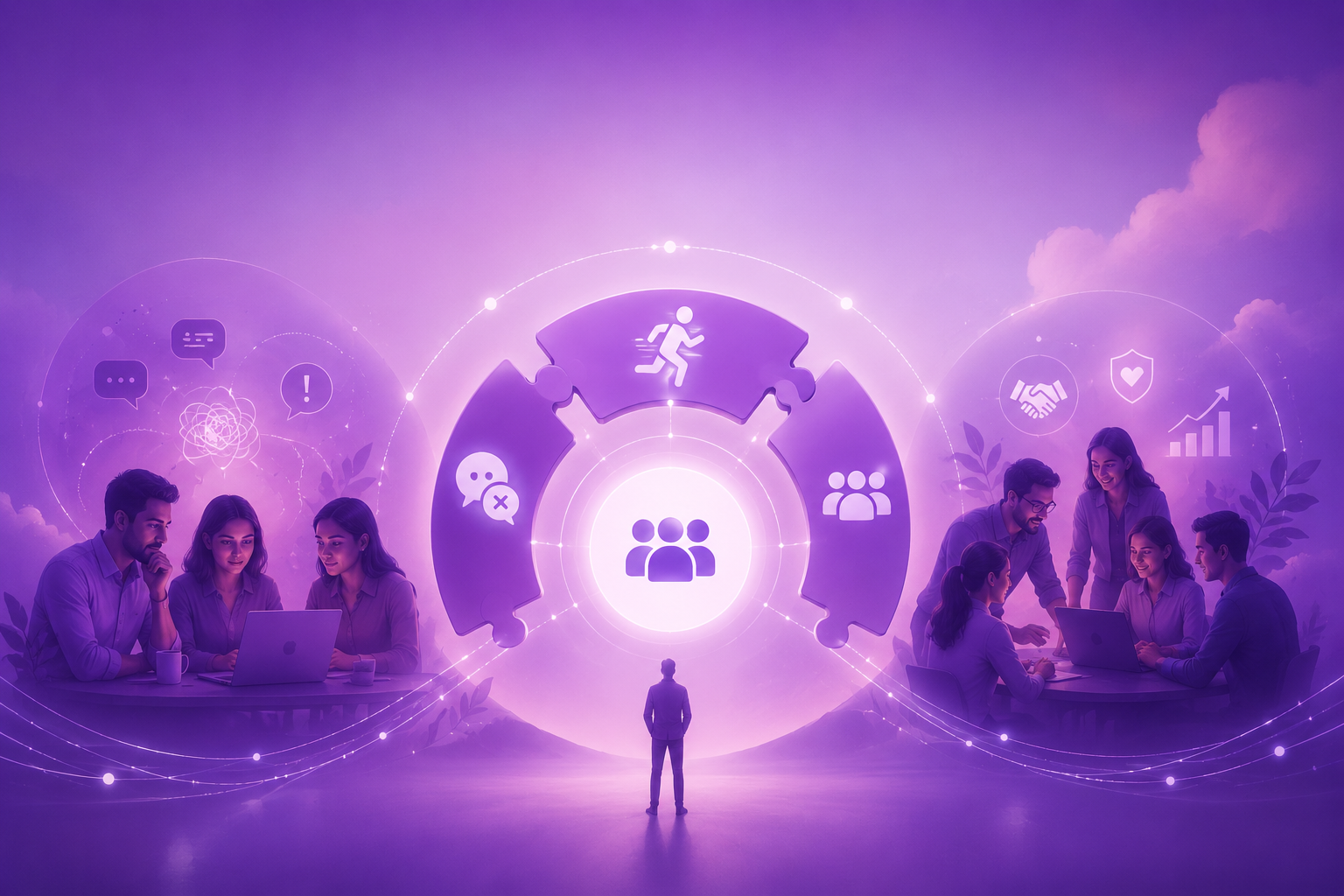
A KaramCX Perspective on Communication, Customer Experience, and Sustainable Human Performance
Modern organizations operate in a world of constant movement.
More meetings.
More platforms.
More metrics.
More notifications.
More pressure to perform faster.
Yet despite unprecedented technological advancement, many businesses still experience:
- employee burnout,
- customer dissatisfaction,
- communication breakdowns,
- emotional fatigue,
- and fragmented collaboration.
Why?
Because performance alone does not create sustainable growth.
Synchronization does.
After more than 25 years working across Customer Experience, Communication, Mediation, IT, and Human Dynamics, I have repeatedly observed that organizations begin losing coherence long before they lose productivity.
The warning signs are often invisible at first:
- teams stop listening deeply,
- departments disconnect emotionally,
- leadership becomes reactive,
- communication becomes transactional,
- and customers begin sensing tension behind the service.
The issue is rarely a lack of talent.
The issue is usually a lack of alignment between people, communication, rhythm, and purpose.
The Three Patterns of Organizational Desynchronization
This section provides a structured comparison of features and pricing to help customers choose the best option for their needs.
| Communication Without Presence | Movement Without Alignment | Growth Without Human Integration |
|---|---|---|
| Many organizations communicate constantly, yet meaningful understanding is missing. | Busy organizations often mistake activity for progress. | Modern companies scale operations rapidly, but often neglect emotional and communicational integration. |
| People exchange information without emotional connection. | New systems are introduced. | This creates: |
| Conversations become functional instead of relational. | Campaigns multiply. | ✕ weak onboarding |
| Listening becomes replaced by reaction. | Processes accelerate. | ✕ disconnected culture |
| This creates: | But without shared rhythm and coherent direction: | ✕ poor internal trust |
| ✕ misunderstanding | ✕ priorities become fragmented | ✕ high employee turnover |
| ✕ defensive communication | ✕ teams lose clarity | ✕ declining profitability |
| ✕ internal tension | ✕ stress increases | ✕ slower organizational scalability |
| ✕ artificial customer interactions | ✕ Flow cannot emerge inside constant fragmentation. | ✕ rising operational costs |
| ✕ Customers immediately feel when communication lacks authenticity. | ✕ Flow cannot emerge inside constant fragmentation. | |
| ✕ True performance requires synchronized movement. |
Technology can automate processes. But it cannot replace human coherence. The future of Customer Experience depends not only on systems — but on the quality of relationships inside organizations.
Introducing the KaramCX Framework
KaramCX is not simply a customer support methodology.
It is a human-centered communication philosophy designed to restore synchronization between:
- people,
- communication,
- workflow,
- leadership,
- and customer experience.
The core idea is simple:
External customer experience is a reflection of internal organizational coherence.
When employees feel disconnected, customers eventually feel it too.
When communication lacks clarity internally, service quality becomes inconsistent externally.
KaramCX combines principles from:
- Customer Experience,
- Mediation,
- Flow Dynamics,
- Emotional Intelligence,
- Communication Strategy,
- and Human Synchronization.
It is a human-centered communication philosophy designed to restore synchronization between:
- people,
- communication,
- workflow,
- leadership,
- and customer experience.
The core idea is simple:
External customer experience is a reflection of internal organizational coherence.
When employees feel disconnected, customers eventually feel it too.
When communication lacks clarity internally, service quality becomes inconsistent externally.
KaramCX combines principles from:
- Customer Experience,
- Mediation,
- Flow Dynamics,
- Emotional Intelligence,
- Communication Strategy,
- and Human Synchronization.
The Difference Between Traditional CX and KaramCX
Find the Right Communication Model for Sustainable Growth
This comparison highlights the difference between transactional customer operations and synchronized human-centered communication.
| Traditional CX Systems | Transitional Organizations | KaramCX Approach |
|---|---|---|
| Focus on metrics only | Beginning cultural awareness | Human-centered synchronization |
| Reactive communication | Partial alignment efforts | Conscious communication flow |
| Scripted empathy | Emotional inconsistency | Authentic relational presence |
| Department silos | Mixed collaboration models | Integrated communication ecology |
| Burnout normalized | Searching for balance | Sustainable human performance |
What Organizations Actually Need Today
Traditional Operational Models
Organizations operating only through pressure and KPIs often experience:
- fragmented communication,
- emotional exhaustion,
- high turnover,
- reactive leadership,
- and declining trust.
These systems may create short-term productivity but rarely long-term coherence.
Transitional Communication Cultures
Some companies recognize the human side of performance and begin introducing:
- wellbeing initiatives,
- emotional intelligence training,
- collaboration practices,
- and leadership transformation.
But without deeper synchronization, these efforts often remain disconnected.
The KaramCX Vision
KaramCX proposes a more integrated model where:
- communication becomes conscious,
- teams operate with shared rhythm,
- mediation replaces unnecessary conflict,
- and customer experience emerges naturally from organizational coherence.
This is not “soft communication.”
It is strategic human alignment.
From Performance Pressure to Sustainable Flow
Many businesses still attempt to optimize customer experience through:
- stricter KPIs,
- increased monitoring,
- scripted empathy,
- and constant acceleration.
But pressure alone cannot create meaningful communication.
People do not remember only solutions.
They remember:
- tone,
- emotional presence,
- clarity,
- trust,
- and how communication made them feel.
The future of Customer Experience may not belong to organizations with the loudest systems.
It may belong to those capable of creating deeper coherence between people, purpose, and communication.
Final Reflection
Most companies do not fail because people stop working hard.
They fail because fragmentation slowly replaces synchronization.
Fragmented communication.
Fragmented attention.
Fragmented leadership.
Fragmented human connection.
Sustainable growth begins when organizations stop treating communication as a mechanical process and start understanding it as a living human ecosystem.
This is the vision behind KaramCX.
Not simply better support.
But better synchronization between people, communication, and collective purpose.