
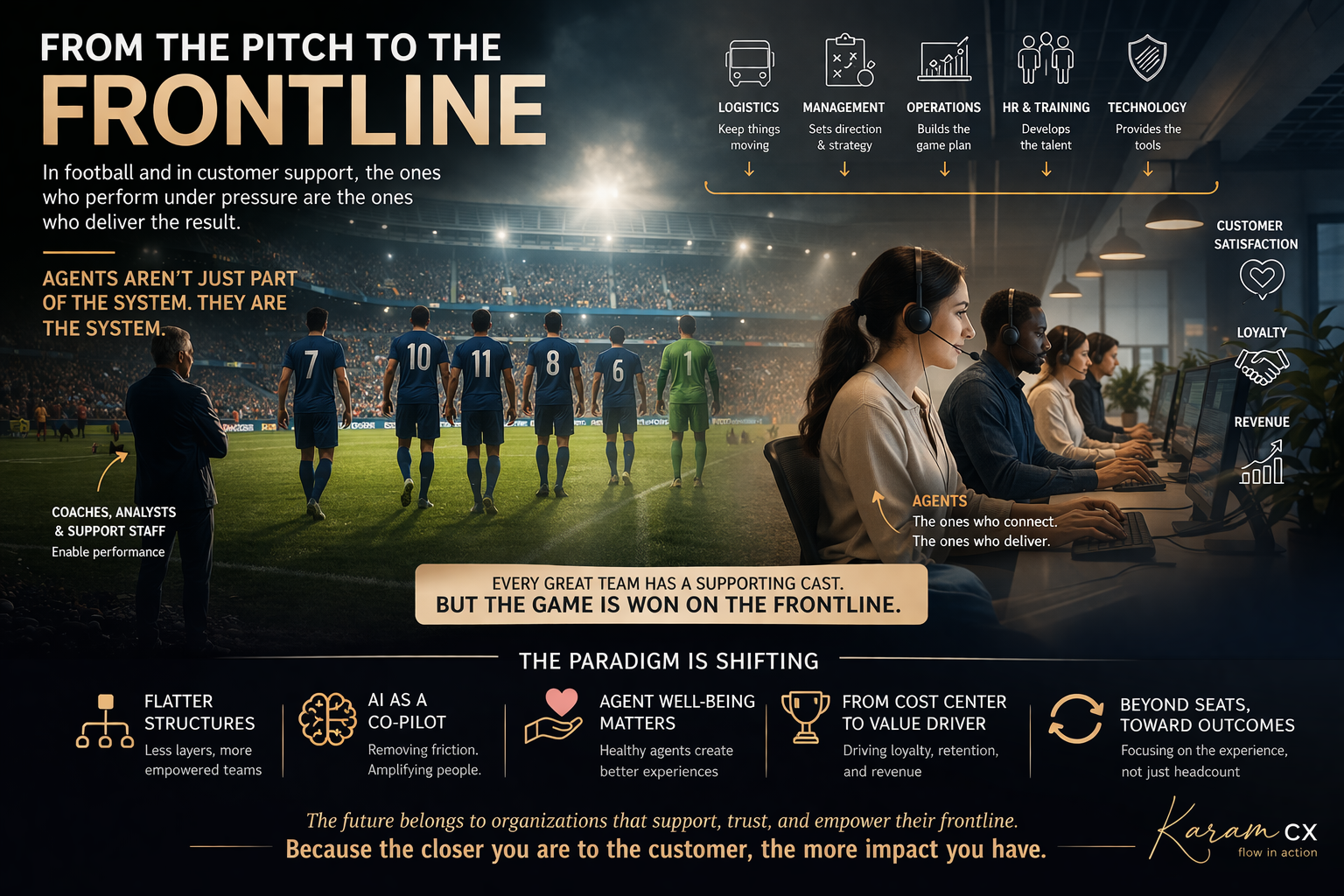
In football, everything ultimately comes down to the 11 players on the field.
They are the ones who perform.
They carry the pressure.
They deliver the result.
Behind them, there is an entire ecosystem—coaches, analysts, management, logistics, even the bus driver. Every role matters. But the outcome of the game is decided on the pitch.
Now, let’s shift this perspective into the world of Customer Experience.
The Frontline Reality
In contact centers and customer support environments, the same dynamic exists.
The agents—the people answering calls, replying to emails, and handling chats—are the ones on the field.
They are:
- The voice of the brand
- The face of the service
- The point where expectation meets reality
Everything else—management layers, reporting structures, workforce planning, training teams—exists to support them.
And yet, for years, the industry has been structured in a way that often places more weight on control systems than on the actual performers.
Where the Value Really Comes From
Most customer support operations are built on a simple economic model: pay per seat.
Clients pay for:
- XYZ number of agents ( 10, 20, 50, 100, etc.)
Each “seat” represents capacity, availability, and service delivery.
But here’s the critical insight:
The revenue comes from the interaction between the agent and the customer.
Not from the layers above.
And yet, as organizations scale, they tend to accumulate:
- Managers of managers
- Complex reporting lines
- Oversight structures that grow heavier over time
This creates a paradox:
The value is created at the edge, but the cost grows in the center.
A Shift Is Happening
Today, this model is evolving.
Not suddenly, but steadily—and in a very real way.
1. Flatter Structures Are Emerging
Organizations are reducing unnecessary layers and increasing autonomy at the team level. The goal is not chaos, but clarity—less friction between decision and action.
2. AI Is Reducing Coordination Overhead
Quality assurance, routing, knowledge retrieval, and even coaching are increasingly supported by intelligent systems.
This doesn’t eliminate people.
It removes inefficiencies around them.
3. Agent Well-being Is Becoming a Business Metric
Burnout, attrition, and disengagement are expensive.
Companies are starting to understand:
A supported agent creates a better customer experience.
This is no longer a “nice to have.” It is operationally essential.
4. From Cost Center to Value Driver
Customer support is no longer just about resolving issues.
It is about:
- Retention
- Loyalty
- Brand differentiation
- Revenue opportunities
The frontline is becoming a strategic asset.
5. The Seat-Based Model Is Evolving
We are moving toward:
- Outcome-based models
- Hybrid human + AI delivery
- Flexible, on-demand support structures
The question is shifting from:
“How many agents do we have?”
to
“What experience are we delivering?”
Rethinking the Role of the Agent
The modern support agent is no longer just an operator.
They are:
- A communicator
- A problem-solver
- A relationship builder
- A real-time decision-maker
In many ways, they are the most important interface between a company and its customers.
And yet, many systems are still designed as if they are replaceable components.
That misalignment is exactly what is now being corrected.
A New Paradigm
We are moving from:
Control-based hierarchies
→ toward
Performance ecosystems centered around the frontline
This doesn’t mean the disappearance of structure.
It means a redistribution of importance.
Less focus on controlling people.
More focus on enabling them.
Less weight in the middle.
More strength at the edge.
Final Thought
If we return to the football analogy:
Winning teams are not built by adding more layers around the players.
They are built by:
- Supporting the players
- Trusting the players
- Developing the players
Customer experience is no different.
The future belongs to organizations that understand a simple truth:
The closer you are to the customer, the more impact you have.
And those who stand at that point—the frontline—are not just part of the system.
They are the system.
At KaramCX, we help organizations empower their frontline, streamline communication, and transform customer experience into real business value—reach out to explore how this can work for you.
#KaramCX #CustomerExperience #CustomerSupport #FutureOfWork #Leadership #CX #FlowInBusiness