
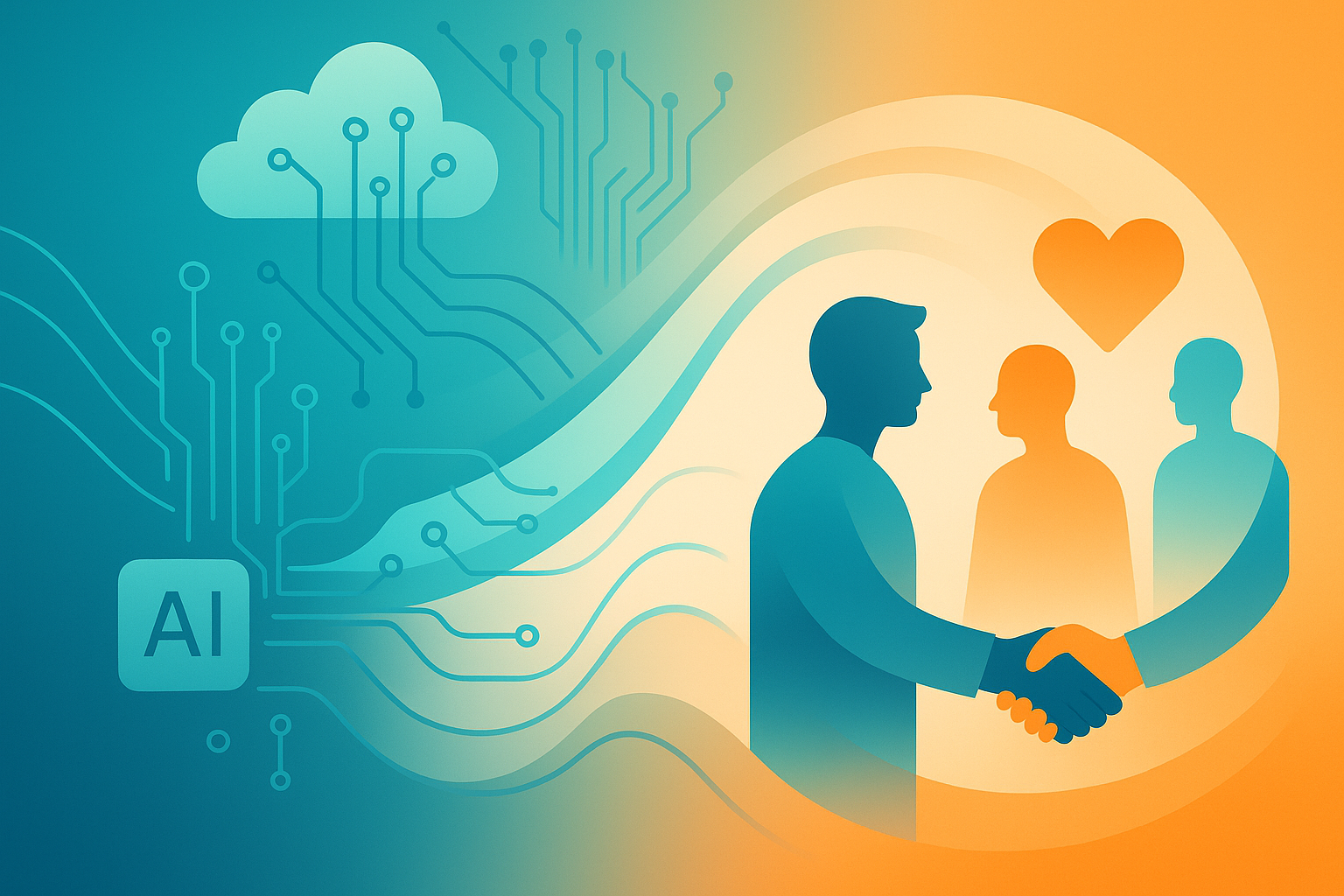
We stand at a threshold. AI isn’t another factory machine that takes away our muscle work. It is a mirror of our own mind, a replica of cognition itself. This is not the Industrial Revolution 2.0. It is the dawn of something more radical: the outsourcing of human thought.
The question is not “Will there be new jobs?” The deeper question is “What is the purpose of society when machines can think faster, cheaper, and broader than us?”
1. The Keyboard Was Our Last Tool
For decades, the West called itself a “services economy.” We typed, we clicked, we designed, we planned, we analyzed, and we attended endless meetings. Our product? Words, numbers, slides, strategies.
But today, everything we do behind a keyboard can be generated by AI. An architect once needed years of study, teams, and drafts to design a home. Now you can give an AI a map location, your taste in light and color, and receive an architectural plan in seconds.
The best architects will still exist, but as curators of taste, not producers of drafts. And this story repeats itself across law, finance, design, marketing, even medicine.
We are moving from:
- Augmented Intelligence → where humans wield AI as a tool.
- Machine Mastery → where humans are optional.
The shift is not theoretical. It’s happening. The funnel of labor is already narrowing.
2. “But there will be new jobs…”
Yes. But fewer than you think.
When tractors came, farmers became factory workers. When factories automated, many became knowledge workers. But what emerges after the knowledge worker is not obvious.
Some spaces will resist automation longer:
- Care work (child care, elder care, animal care, healing).
- Embodied trades (plumbing, electrical, repair, climate adaptation).
- Human presence (storytelling, coaching, companionship, creativity).
Geoffrey Hinton — the “godfather of AI” — told a room full of CEOs: “Train to be a plumber.” He wasn’t joking. Robotics still lags, but when hardware catches up, even those spaces will shrink.
So the honest truth is this: the most resilient jobs will be those rooted in connection — human to human, human to nature, human to self.
3. Beyond Work: The Economics of Flow
The deeper challenge isn’t employment. It’s identity.
We have been conditioned — generation after generation — to believe our worth is tied to our productivity. To be a “gear” in the capitalist machine. But look closer: what do most humans truly want?
- To hug their children.
- To share a good meal.
- To love and be loved.
- To dance, to rest, to laugh, to belong.
These are not luxuries. They are the essence of being alive. In Latin America, people work enough to eat and then spend the night in music and dance. In parts of Africa, people sit on sidewalks full of laughter. They are not less human than us. Perhaps, they are more free.
AI gives us a choice: do we double down on scarcity and competition? Or do we let go, redistribute, and allow humanity to finally breathe?
4. Budgets Reveal Priorities
Here is the hard arithmetic:
- The world spends $2.7 trillion every year on military.
- With just 10–12% of that, we could end extreme poverty.
- With less than 4%, we could end world hunger.
- With 10–12%, we could give universal healthcare to every person alive.
- Redirect the full budget, and we could tackle climate change meaningfully.
We already spend enough to transform Earth into a flourishing garden. But instead, we turn those trillions into smoke, metal, and ashes.
So the question is not “Can we afford universal dignity?” The question is: “Can we afford to keep choosing war over life?”
5. Preparing Before the Collapse
COVID showed us what happens when we react too late (or even wrongly) . AI is another labor disruption. Waiting until millions lose their jobs before acting is negligence.
We must prepare now:
- Reskill into trades and care work.
- Pay people for presence and community, not just throughput.
- Reallocate military budgets to universal floors: food, health, housing.
- Design policies for augmentation before automation.
Above all, we must shift our cultural KPI: from GDP to time, love, and joy.
6. Utopia or Dystopia — Our Choice
If we let elites hoard AI, declare the rest “eaters,” and govern by algorithmic force, we will build a dystopia of precision oppression.
If we redistribute, reimagine, and re-root society in connection, AI can be the great liberator — removing drudgery and giving humans back their time.
The path to utopia is not in the silicon. It is in us. In whether we choose flow, balance, and shared dignity over fear and control.
🌿 Final Word
AI is not destiny. It is a mirror. It shows us the truth about our systems: that they were always about power, not about people.
But it also gives us a new chance — to step out of the machine, to return to what is most human: love, care, dance, creation, belonging.
If we are brave enough to shift our priorities, we may discover that the Age of AI is not the end of work — it is the beginning of a more humane world.
✨ The real revolution is not artificial intelligence. It is authentic humanity.